
For years, automated phone systems were universally loathed. We’ve all been trapped in automated IVR hell, shouting “Representative!” into our smartphones while a mechanical voice misinterprets our inputs.
But things have fundamentally changed. Powered by advanced Large Language Models (LLMs), real-time neural speech synthesis, and ultra-low latency orchestration, modern conversational AI can now hold fluid, natural human conversations over the phone.
Standing at the absolute forefront of this technological shift is Vapi AI.
Marketed as an enterprise-grade voice orchestration platform, Vapi allows developers and businesses to build, test, and deploy human-like voice agents in a matter of hours. But is it truly the future of conversational AI, or is it too complex for the average business owner?
In this comprehensive Vapi AI review, we break down its features, real-world pricing, core benefits, and limitations to help you decide if it’s the right tool for your automation stack.
What Exactly is Vapi AI?
Vapi is a developer-first voice AI orchestration platform. It does not build proprietary language models or voice synthesizers. Instead, it acts as the underlying “plumbing” that unifies three core pillars of voice AI into a single, lightning-fast pipeline:
- Speech-to-Text (STT): Transcribing what the human caller says in real time (using engines like Deepgram or Nova-2).
- Large Language Models (LLMs): Processing the text, understanding the intent, and generating a response (using models like OpenAI GPT-4o, Anthropic Claude 3.5, or custom fine-tuned models).
- Text-to-Speech (TTS): Converting that response back into human-like audio (using elite voice engines like ElevenLabs, Play.ht, or LMNT).
By abstracting away the complex infrastructure required to sync these layers, Vapi allows you to launch an inbound or outbound voice agent with a custom phone number in under an hour.
The Standout Features of Vapi AI
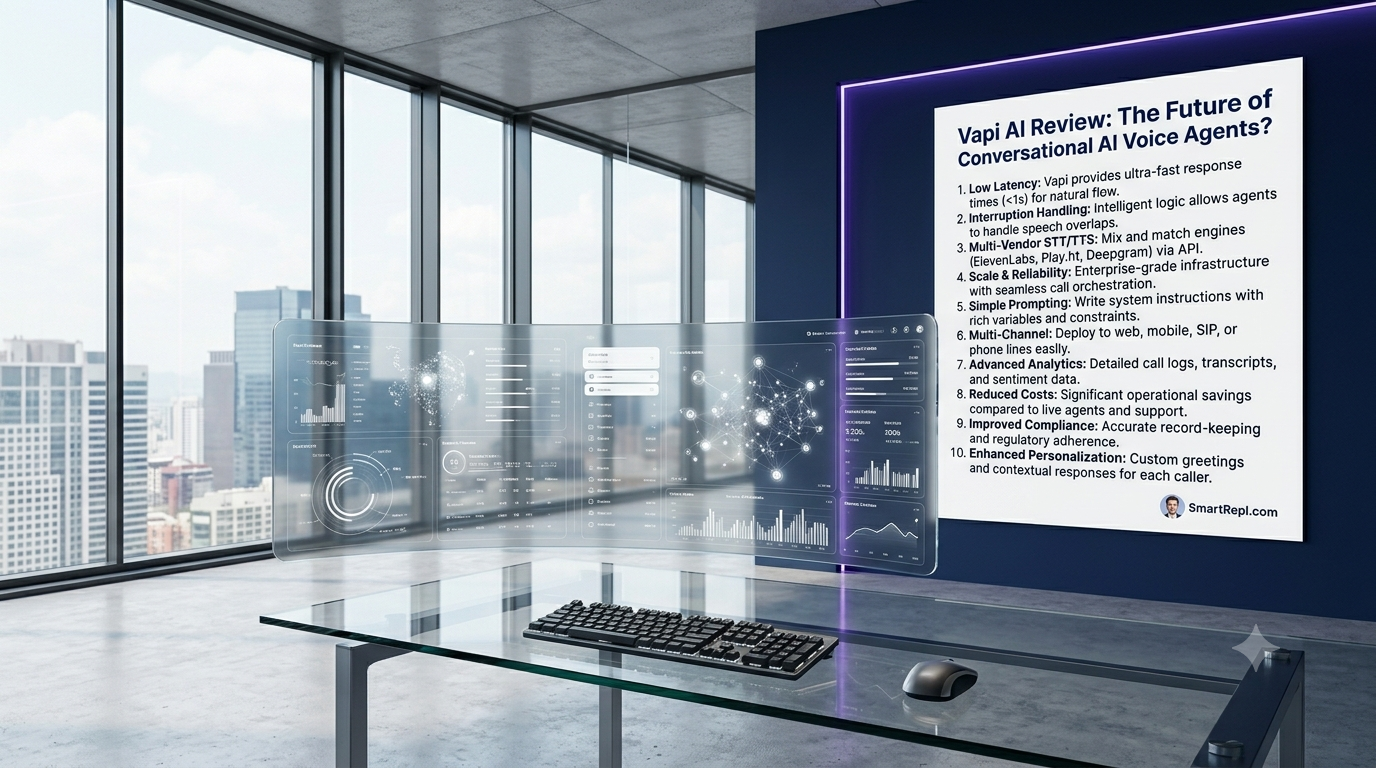
1. Ultra-Low Latency (<500ms Response Times)
The biggest killer of conversational flow is silence. If an AI assistant takes two or three seconds to reply, the call feels disjointed and awkward. Vapi uses specialized WebRTC streaming architecture to achieve an average latency of under 500 milliseconds. This makes conversations feel incredibly responsive, fluid, and natural.
2. Intelligent Endpointing & Interruption Handling
Humans interrupt each other during natural conversation. Most basic voicebots will clumsily keep talking over a user until their pre-generated audio script finishes. Vapi features advanced smart endpointing and turn-taking logic. If a human cuts off the AI voice agent mid-sentence, the agent instantly stops speaking, listens to the new input, and adapts its response immediately.
3. Complete Modular Flexibility (Bring Your Own Keys)
Vapi doesn’t lock you into a single ecosystem. You can fully customize your stack depending on your performance benchmarks and budget. Want to use Deepgram for blazing-fast transcription, Anthropic Claude for deep reasoning, and ElevenLabs for an ultra-premium emotional voice tone? Vapi allows you to mix and match providers seamlessly by plugging in your own API keys.
4. Over 4,200 Fine-Tuning Configuration Points
For engineering and product teams, Vapi offers unprecedented control. Through their dashboard or API, you can fine-tune conversational parameters such as:
- Backchanneling (making the AI say “mm-hmm” or “got it” while listening).
- Max call duration limits.
- Temperature and prompting styles for specific call flows.
- Background noise suppression levels.
Vapi AI Pricing Explained
Vapi utilizes a highly scalable, usage-based pricing structure. However, understanding the true cost requires looking beyond their baseline platform fee.
- Vapi Platform Fee: A flat $0.05 per minute for orchestration.
- The “Hidden” Vendor Costs: Because Vapi passes through the infrastructure costs of the providers you choose, your total cost will fluctuate based on your configuration:
- Telephony (Twilio/SIP): ~$0.01 – $0.03 / min
- Transcription (STT): ~$0.01 – $0.02 / min
- LLM Inference (GPT/Claude): ~$0.02 – $0.10 / min
- Voice Synthesis (ElevenLabs): ~$0.05 – $0.15 / min
The Bottom Line: On average, running a highly realistic, production-ready Vapi voice agent costs roughly $0.15 to $0.25 per minute. Compared to the cost of a live human receptionist or call center agency, this represents an immediate 80%+ reduction in operational overhead.
n8n vs. Zapier vs. Vapi: Where Does It Fit?
A common point of confusion is how Vapi interacts with workflow orchestration platforms like n8n or Zapier.
The distinction is simple: Vapi handles the voice conversation itself, while tools like n8n or Make handle the backend actions triggered by that conversation.
For instance, using Vapi’s native Function Calling (Tools) feature, the voice agent can tell an external webhook: “The customer wants to book an appointment for Tuesday at 3 PM.” Vapi sends that payload to n8n, which autonomously updates your Google Calendar, pushes data into HubSpot CRM, and sends a confirmation text via Twilio.
The Pros and Cons of Vapi AI
👍 The Pros:
- Unmatched Prototyping Speed: Go from an idea to a ringing AI phone agent in minutes.
- Industry-Leading Latency: Easily outpaces traditional open-source DIY pipelines.
- Developer-First Design: Clean APIs, robust documentation, and detailed debugging logs.
- Highly Scalable: Handles thousands of concurrent calls effortlessly without server provisioning.
👎 The Cons:
- Not a Turnkey Product: Vapi is a development platform, not an out-of-the-box software app. If you don’t know how to write prompts, structure system instructions, or work with APIs, you will need a developer to build a production-ready agent.
- Complex Multi-Vendor Billing: Because costs are split across Vapi and your chosen LLM/voice providers, tracking precise margins requires careful monitoring.
Final Verdict: Is Vapi AI Worth It?
If you are a tech-savvy business owner, agency builder, or developer looking to deploy cutting-edge voice automations, Vapi AI is an absolute game-changer. Its ability to mimic realistic human cadence, handle interruptions elegantly, and scale cost-effectively places it at the absolute pinnacle of the conversational AI landscape.
However, if you are looking for a simple “plug-and-play” solution where you don’t have to manage prompting logic or webhook configurations, you may find the platform setup steep without technical assistance.
🚀 The verdict? Vapi is providing the definitive engine powering the future of automated customer voice operations.
💡 Want to see how to connect your voice agents to the rest of your software stack? Read our deep-dive n8n Review: The Ultimate Powerful Alternative to Zapier? to maximize your backend automation.